
Landing Page Design for Agencies & Local Businesses
Landing page design looks different depending on who is building it and who it serves. An agency building pages for a dozen clients needs repeatable process without cookie-cutter output; a local business building its own page needs to earn trust fast with no brand recognition to lean on. Both goals are the same — get the right visitor to take one clear action — but the path there diverges at almost every step.
- Two Starting Points: Agency Workflow vs. Owner-Operator Reality
- What Agencies Should Standardize (Without Making Every Page Look the Same)
- Local Business Landing Pages: The Trust-First Approach
- Budget Tiers: What You Actually Get at Each Price Point
- Client Onboarding: Getting the Inputs You Actually Need
- Common Pitfalls, Agency Side and Client Side
- The AI Search Era: What Changes for Both
- Salterra's Take
This piece is for two audiences: agencies who design landing pages as a service, and local business owners building or commissioning their own. We’ll flag where the advice splits.
Two Starting Points: Agency Workflow vs. Owner-Operator Reality
An agency is usually solving for scale and consistency. You’re building landing pages for plumbers, dentists, HVAC companies, and law firms in the same quarter, and each one needs to feel bespoke even though your underlying process — discovery call, offer definition, wireframe, build, QA, launch — barely changes. The risk is templating so hard that every page reads like a reskin, which clients notice and which can produce near-duplicate page structures across a portfolio of sites you manage.
A local business owner is usually solving for credibility with zero marketing infrastructure behind them. They don’t have a design system or five other pages to compare against, and they often don’t have anyone in-house who has looked at a hundred landing pages and knows what converts. Their page has to do more persuasive work per pixel because there’s no brand equity carrying it.
The practical implication: agencies should build a flexible framework, not a rigid template, that changes visual language per client but keeps the underlying conversion logic — offer, proof, objection handling, single call-to-action — constant. Local businesses should borrow proven structure rather than inventing their own, since the cost of getting it wrong is a page that never converts and nobody catches why.
What Agencies Should Standardize (Without Making Every Page Look the Same)
Standardize process, not pixels. The parts of a build that benefit from a repeatable system are the parts clients never see: intake questionnaires that force a client to articulate their offer and target customer before design starts, a QA checklist that catches broken forms and slow-loading hero images, and a versioning convention so revisions don’t turn into a pile of “final_v3_USE_THIS” files.
What should not be standardized is the visual system and the specific proof elements. A landing page for a personal injury attorney shouldn’t share a hero layout, color logic, or headline formula with one for a boutique HVAC company just because they came out of the same agency in the same month. Search engines and users both notice pattern-matched pages, and Google’s helpful content systems are explicitly built to de-rank content that reads as templated rather than purpose-built for a specific business and audience.
- Standardize: intake forms, QA checklists, tracking setup (Google Tag Manager, call tracking), accessibility baseline, page-speed budget.
- Customize per client: headline and offer language, visual identity, proof elements (reviews, credentials, case photos), form length and fields.
Local Business Landing Pages: The Trust-First Approach
When you’re a local business without a recognizable brand, the landing page’s first job isn’t persuasion — it’s proof that you’re real and reputable. That means leading with specifics: a named owner or team, a service area stated plainly, years in business, and photos of your actual work, not stock imagery of generic smiling professionals.
Local landing pages also convert better when they mirror how the customer is actually searching. Someone searching “emergency plumber near me” wants a phone number, a response-time promise, and evidence you show up — not a research mindset. Someone comparing “best local SEO agency” is researching and will tolerate a longer page with process detail, case examples, and FAQs. Matching page depth to search intent matters more for local businesses than for agencies running paid lead-gen funnels, because local pages are far more likely to be found organically or through Google Business Profile, where intent varies more widely.
A pitfall specific to local businesses: copying a competitor’s page structure wholesale. A page built to look like a leader’s page without the underlying proof — real reviews, real credentials — reads as hollow to both visitors and to search systems evaluating expertise and trust.
Budget Tiers: What You Actually Get at Each Price Point
Agencies quoting landing page work, and local businesses shopping for it, both benefit from an honest map of what each budget buys.
- Template plus copy edit: A page builder theme (Elementor, Divi, Unbounce, Leadpages) with client-specific copy and images swapped in. Fast and low-cost — but it rarely reflects the brand deeply and its conversion ceiling is lower.
- Custom design, templated build: A bespoke layout in Figma, built on a flexible CMS. The sweet spot for most local businesses and agency clients — real differentiation without a fully custom codebase.
- Fully custom build with testing program: Bespoke design, custom development, and an ongoing testing cadence (A/B tests via VWO or Optimizely, heatmaps via Hotjar or Microsoft Clarity). Worth it once paid traffic volume is high enough that a conversion lift pays for the ongoing work.
The mistake we see most often at Salterra: businesses buying tier-three ambition on a tier-one budget, expecting a template swap to perform like a fully tested, custom-built page.
Client Onboarding: Getting the Inputs You Actually Need
Most landing page failures trace back to onboarding, not design. If an agency doesn’t extract a clear, singular offer before wireframing starts, the page ends up trying to sell three services at once, with a form asking for information nobody wants to give before they trust you.
A working intake process asks for: the single action the page should drive (call, form fill, booking, purchase), who specifically it’s for, what objection stops that person from converting today, and what proof the business can actually produce, not what it wishes it had. Owners doing this themselves should write these four answers down before opening a page builder — it forces clarity that’s otherwise easy to skip.
Agencies should also ask what happens after submission. A page connected to a lead notification that goes unanswered for two days is a wasted build no matter how well it converts — call tracking (CallRail) and a Zapier-driven notification chain matter as much as the design itself.
Common Pitfalls, Agency Side and Client Side
On the agency side, the recurring failure is treating the landing page as a design deliverable rather than a conversion system. A beautifully designed page with a form that isn’t connected to anything, or a call-to-action button that doesn’t stand out from decorative elements, will underperform a plainer page that gets the fundamentals right.
On the client side, the recurring failure is scope creep disguised as “just one more thing” — a services menu, then a blog feed, then a second contact form, until the page slowly turns back into a mini homepage with no single job. Part of an agency’s value is holding that line even when the client pushes.
A shared pitfall: skipping mobile review before launch. Local business pages get the majority of their traffic on phones, especially from Google Business Profile and map-pack clicks. A hard-to-tap call-to-action or a click-to-call button buried below the fold on mobile will quietly bleed conversions that never show up as an obvious “bug.”
The AI Search Era: What Changes for Both
AI-generated search summaries and chat-based assistants are increasingly the first touchpoint for research-stage queries, which changes what a landing page needs to do once a visitor arrives. If a prospective customer has already read an AI Overview or asked a chatbot to compare local providers, they’re arriving later in their decision process, often already narrowed to two or three options. The page needs to answer the comparison questions those tools tend to surface — pricing structure, service area, turnaround time, guarantees — clearly near the top, not buried three screens down.
For agencies, this also means the intake and proof elements you gather for a client — credentials, named staff, specific service details — do double duty: they support persuasion and give AI systems concrete facts to cite. Vague, adjective-heavy copy serves neither audience well anymore.
Salterra's Take
Since 2011 we’ve built landing pages for both audiences described here, and the pattern holds: the pages that keep converting years later are built on a real, specific offer and real proof, not clever design tricks. Design matters — it removes friction and builds trust faster — but it can’t manufacture credibility that isn’t there. Agencies that internalize this stop over-promising on template work, and local businesses stop shopping for a “prettier” page when what they actually need is a clearer offer and better proof.
Frequently Asked Questions
Should an agency use the same landing page template for every client?
No. Standardize your process — intake, QA, tracking setup — but keep the visual design and proof elements specific to each client. Heavily templated pages read as generic to both visitors and to search systems that evaluate whether content was built for a specific audience.
How much should a local business budget for a landing page?
It depends on the tier: a template-plus-copy build is the cheapest and fastest but has a lower conversion ceiling; a custom-designed page on a flexible CMS is the sweet spot for most local businesses; a fully custom build with an ongoing testing program only pays off once traffic volume is high enough to justify it.
What's the biggest mistake local businesses make with landing pages?
Trying to do too much on one page — adding a services menu, a blog feed, and multiple contact forms until the page loses its single, clear job. A focused page with one offer and one call-to-action consistently outperforms a page trying to be a mini homepage.
What onboarding questions should an agency ask before designing a landing page?
At minimum: what single action the page should drive, who specifically it's for, what objection is stopping that person from converting today, and what proof the business can genuinely produce. Skipping this step is the most common root cause of underperforming pages.
Does mobile design matter more for local business landing pages?
Yes, disproportionately. Local landing pages get a large share of traffic from Google Business Profile and map-pack clicks, which are overwhelmingly mobile. A hard-to-tap call button or an overly long form on mobile will quietly suppress conversions even when desktop performance looks fine.
How does AI search change landing page design for agencies and local businesses?
Visitors increasingly arrive after already researching via an AI summary or chatbot, so they're further along in comparing options. Landing pages need to surface concrete, comparison-ready facts — pricing structure, service area, guarantees — clearly near the top rather than relying on vague, persuasive copy alone.
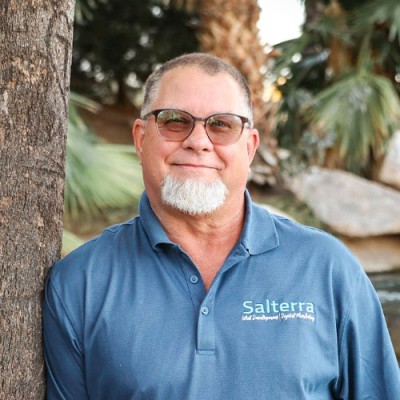
Terry has 30+ years in software and SEO. He’s the founder of Salterra Digital Services and SEO Spring Training, host of the Roundtable SEO Mastermind, and lead instructor at SEO University — teaching the exact tactics his team uses on client work.
Continue learning
Ready to master this?
This guide is one lesson from the Conversion-Focused Web & Landing Page Design course. Get every lesson, framework and checklist — plus the full 38-course catalog — inside SEO University.
Practitioner-focused training across the full digital marketing stack — from technical SEO to conversion optimization and the AI search era. By Salterra Digital Services, since 2011.