
Local SEO Checklist: The Essential Best Practices
A local SEO checklist covers six core areas: Google Business Profile setup and ongoing management, NAP consistency across citations and directories, local pack ranking signals, review generation and response, local landing page optimization, and schema markup. Get all six right and your business becomes the obvious answer when nearby customers search — and increasingly, when AI-powered local answers surface in Google’s AI Overviews, ChatGPT, and Perplexity.
This checklist is built from practitioner work, not theory. Terry Samuels and the team at Salterra Digital Services have been doing local SEO for real clients since 2011 — service-area businesses, multi-location retailers, medical practices, law firms, home services. The items below are the ones that consistently move rankings and drive calls.
Google Business Profile: Foundation First
Your Google Business Profile (GBP) is the single highest-leverage asset in local SEO. It feeds the local pack (the map and three-listing block that appears above organic results), it populates Google Maps, and it is a primary data source for AI-generated local answers. A neglected or incomplete profile is the most common reason a local business fails to appear where it should.
- Claim and verify your listing if you have not already. Unverified profiles are deprioritized and vulnerable to edits from anyone.
- Choose your primary category carefully. This is the single most influential ranking signal in GBP. Pick the most specific category that accurately describes your core business — not a broader parent category.
- Add all relevant secondary categories for additional services. A plumbing company might add “Water Heater Repair” and “Drain Cleaning Service” as secondary categories.
- Fill every field: business description, website URL, phone number, hours (including holiday hours), service area if applicable, and attributes (wheelchair accessible, women-led, appointment required, etc.).
- Upload real photos regularly. Businesses with more than 100 photos get significantly more views and direction requests. Add exterior, interior, team, and product/service photos. Use descriptive file names before uploading.
- Post to GBP weekly. Updates, offers, and events keep your profile fresh and signal active management to Google.
- Add your full service menu or product catalog using the Products and Services sections. These feed directly into how AI answers describe what you offer.
NAP Consistency: The Citation Foundation
NAP stands for Name, Address, Phone Number. Consistent NAP across every online directory, social profile, and data aggregator is a foundational trust signal for local SEO. When your information conflicts — old suite number on one site, truncated business name on another — Google and AI systems have to resolve the contradiction. Uncertainty reduces citation confidence and can suppress your rankings.
- Decide on your canonical NAP format before you build citations. Choose one consistent version: exactly how your business name appears on your sign, the full street address format you want Google to use, and one primary phone number.
- Audit existing citations using a tool like BrightLocal, Whitespark, or Moz Local. Find every listing that has old addresses, old phone numbers, misspelled names, or missing data.
- Fix or suppress duplicate listings. Duplicate GBP listings and duplicate citations dilute your authority and confuse AI entity resolution. Clean these up before building new citations.
- Build citations on the core data aggregators: Data Axle, Neustar Localeze, and Foursquare. These feed hundreds of downstream directories automatically.
- Prioritize niche and industry-specific directories over generic link farms. A law firm on Avvo and FindLaw carries more weight than fifty low-quality general directories.
- Add your NAP to your website’s footer and mark it up with LocalBusiness schema so Google can read the canonical version directly from your own domain.
Local Pack Ranking Signals
The local pack is driven by three factors: relevance (does your business match the search intent?), distance (how close is your business to the searcher?), and prominence (how well-established is your business online?). You cannot control distance, but relevance and prominence are entirely within your control.
On-GBP signals
Category selection, keyword usage in your business description, completeness of all profile fields, and the volume and recency of your posts are all relevance signals Google reads directly from your profile. Mention your primary services and service cities naturally in your description — not keyword stuffing, just clear, accurate language.
On-site local signals
Your website must clearly signal your location and service area. Include your city and region in title tags, H1s, and body copy on your key service pages. Embed a Google Map on your contact page. Build a service area page or individual landing pages for each city you serve. Link your website to your GBP and keep the NAP on the site identical to your GBP.
Off-site authority signals
Inbound links from locally relevant and industry-relevant domains lift your prominence score. Local sponsorships, chamber of commerce memberships, local news coverage, and partnerships with complementary local businesses are all legitimate link-building paths that also build real entity authority in the knowledge graph.
Review Strategy: Volume, Velocity, and Response
Reviews are a direct local pack ranking factor and a powerful conversion signal. A business with 200 reviews at 4.6 stars consistently outranks a comparable business with 12 reviews at 5.0 stars. Volume and recency matter as much as rating.
- Create a friction-free review link. Use Google’s review link generator or a tool like Whitespark to build a direct URL that opens the review form. Put it in your post-service emails, text messages, and invoices.
- Ask at the moment of peak satisfaction — right after a job is completed, a prescription is filled, or a great meal is eaten. The ask has to be personal and timely, not a mass email blast three weeks later.
- Train every customer-facing team member to verbally ask for reviews. One confident verbal ask at checkout generates more reviews than a dozen automated follow-up emails.
- Respond to every review, positive and negative, within 24–48 hours. Responses show Google you are an active, engaged business. Thoughtful responses to negative reviews demonstrate professionalism and often matter more to prospective customers than the negative review itself.
- Never buy reviews or incentivize them with discounts. Google’s review policy prohibits this. The risk of suspension or review stripping far outweighs any short-term volume gain.
- Diversify beyond Google. Yelp, Facebook, industry-specific review sites (Houzz for contractors, Healthgrades for medical, Avvo for legal), and BBB all feed AI systems that synthesize your reputation from multiple sources.
Local Landing Pages: One Page Per City, Per Service
If you serve multiple cities or offer multiple distinct services, a single generic homepage cannot rank for all of them. Local landing pages give Google a targeted, specific signal for each location-service combination — and give potential customers a page that actually addresses their specific situation.
- Build one page per service per city that you seriously want to rank in. A plumber serving five cities with six services has up to 30 potential landing pages. Prioritize by revenue opportunity.
- Write unique, substantive content on every page. Thin pages with only the city name swapped in are a Google Helpful Content Update red flag. Include genuinely local detail: nearby landmarks, local ordinances that affect your service, local testimonials if you have them, specific project experience in that area.
- Use the target city in the H1, title tag, meta description, and first paragraph. This is basic but frequently missed. “Plumbing Services in Scottsdale, AZ” beats “Expert Plumbing Services” for local intent.
- Embed a local map and include your service area’s NAP on each landing page. If you have a physical location in that city, use that address. If not, list the service area clearly with LocalBusiness schema.
- Link local landing pages from your GBP. Use the “Website” URL on your GBP to point to the most relevant landing page for your primary location, and use the Posts feature to link to landing pages for specific services.
- Build internal links between your local pages and your service pillar pages. A well-structured local content hub — with a services overview linking out to city pages, and city pages linking back — signals topical authority across your service area.
Schema Markup for Local Businesses
LocalBusiness schema (and its subtypes — MedicalBusiness, LegalService, FoodEstablishment, HomeAndConstructionBusiness, and others) tells AI systems and search engines exactly what kind of business you are, where you operate, and how to contact you. It is one of the clearest machine-readable signals you can implement, and it directly feeds AI Overviews and AI-powered local answers.
- Implement LocalBusiness schema on your homepage and every local landing page. At minimum include: @type, name, address (with full PostalAddress), telephone, url, openingHoursSpecification, and geo coordinates.
- Use the most specific subtype available. Dentist is better than MedicalBusiness. Plumber is better than HomeAndConstructionBusiness. Specific types help AI systems categorize and surface you for the right searches.
- Add hasMap linking to your Google Maps listing and sameAs pointing to your GBP URL, Yelp page, Facebook page, and other authoritative profiles. This strengthens entity disambiguation.
- Implement AggregateRating schema if you display reviews on your site. This feeds star ratings into search results and AI-generated answers.
- Add FAQPage schema to your local pages for common questions (“Do you serve Gilbert, AZ?”, “What are your emergency plumbing hours?”). AI systems pull these directly when users ask location-specific questions.
- Validate every schema implementation using Google’s Rich Results Test and Schema.org’s validator before and after any site updates.
AI Search and the Local Business: What Is Changing
Google’s AI Overviews increasingly produce local answers — recommending specific businesses, summarizing reviews, and comparing options — without the user ever clicking a blue link. ChatGPT with browsing, Perplexity, and similar tools pull from GBP data, citation directories, review platforms, and your website simultaneously. The entities with the clearest, most consistent signals across all these sources get cited first.
What this means practically: every item on this checklist becomes more important, not less, as AI-powered search grows. The businesses that dominate AI local answers are the ones with complete GBP profiles, clean NAP across all directories, high review volume on multiple platforms, and substantive local landing pages with proper schema. There is no separate “AI optimization” strategy for local — the fundamentals are the strategy.
At Salterra Digital Services, when we audit a local business’s digital presence, we still find that most clients have not completed the basics: unverified GBP listings, NAP conflicts across a dozen directories, zero responses to recent negative reviews, and a single homepage trying to rank for every city they serve. Fix the basics first. The advanced work only amplifies a solid foundation.
Frequently Asked Questions
How long does local SEO take to work?
For businesses starting from scratch, meaningful local pack movement typically takes three to six months of consistent work — GBP optimization, citation cleanup, and early review velocity. Businesses in low-competition markets can see results faster; highly competitive local niches (personal injury law, HVAC, dental) may take six to twelve months to break into the top three local pack positions.
What is the most important local SEO ranking factor?
Google Business Profile relevance — specifically, your primary category selection and the completeness of your profile — is consistently the highest-leverage single factor for local pack rankings. After GBP, review volume and recency, proximity to the searcher, and on-site local signals (city in title tag, landing pages, LocalBusiness schema) all contribute significantly.
Do I need a physical address to rank in the local pack?
You need a verified address in Google Business Profile to appear in the local pack, but that address does not have to be a public storefront. Service-area businesses (plumbers, cleaners, home inspectors) can hide their address in GBP and define a service area instead. Google will still rank you in the local pack within your defined service area — you just will not appear in searches for cities outside it.
How many Google reviews do I need to be competitive?
The right number depends on your market and niche. Search your primary keyword and check how many reviews the current top-three local pack listings have — match or exceed that number to be competitive. In most mid-sized markets, 50–150 reviews at 4.5 stars or above is enough to be in contention. In major metros or saturated niches, the bar can be several hundred.
Can I use the same content on multiple local landing pages?
No — duplicate or near-duplicate local landing pages are a Helpful Content Update risk and a wasted opportunity. Each local page needs genuinely unique content that addresses that specific city or service area. Shared boilerplate is fine for basic business information, but the substantive content — service descriptions, local context, testimonials, FAQs — must be distinct and locally relevant on each page.
Does my website need to be in the same city as my business to rank locally?
No. Your web hosting location has no bearing on local SEO rankings. What matters is that your website clearly signals your physical location and service area through on-page content, LocalBusiness schema, internal linking, and a verified, consistent GBP — not the geographic location of your server.
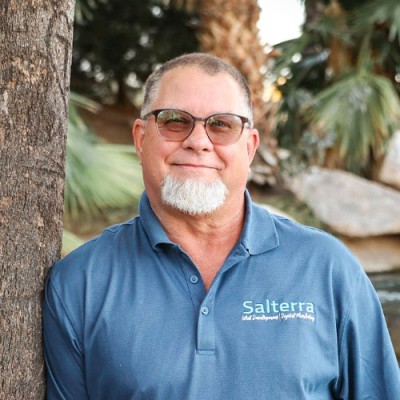
Terry has 30+ years in software and SEO. He’s the founder of Salterra Digital Services and SEO Spring Training, host of the Roundtable SEO Mastermind, and lead instructor at SEO University — teaching the exact tactics his team uses on client work.
Continue learning
Ready to master this?
This guide is one lesson from the Local SEO Complete System course. Get every lesson, framework and checklist — plus the full 38-course catalog — inside SEO University.
Practitioner-focused training across the full digital marketing stack — from technical SEO to conversion optimization and the AI search era. By Salterra Digital Services, since 2011.